Pearl Harbor
"a date that will live infamy"
The attack on Pearl Harbor was a surprise military strike conducted by the imperial Japanese Navy against the United State naval base at Pearl Harbor, Hawaii, on the morning of December 7, 1941. The attack led to the United States' entry into World War II. President Franklin Roosevelt called December 7 1941 "a date that will live infamy"

What caused the attack on Pearl Harbor?
The causes of the attack on Pearl Harbor originated from intensifying Japanese-American rivalry in the Pacific. Japan’s imperial ambitions had been evident from as early as 1931, when she invaded Manchuria. The conquered region’s bountiful resources were then used to supply Japan’s war machine. Leaving the League of Nations in 1933, Japan pursued an aggressive foreign policy aimed at creating the ‘Greater East Asia Co-prosperity Sphere’s understatement for the Japanese empire modeled on European ones of the 19th century.

What happened on 7 December 1941?
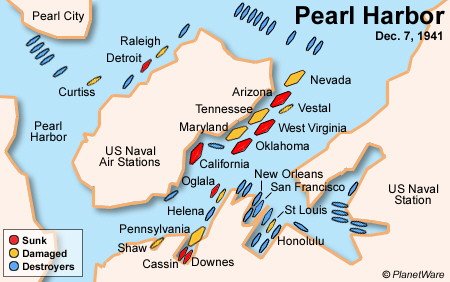
On the morning of December 7, 1941, the Japanese launched a surprise air attack on the U.S. Naval Base at Pearl Harbor in Hawaii. After just two hours of bombing, more than 2,400 Americans were dead, 21 ships had either been sunk or damaged, and more than 188 U.S. aircraft destroyed. The attack at Pearl Harbor so outraged Americans that the U.S. abandoned its policy of isolationism and declared war on Japan the following day, officially bringing the United States into World War II. Sunday mornings were a time of leisure for many U.S. military personnel at Pearl Harbor. Many were either still asleep, in mess halls eating breakfast, or getting ready for church on the morning of December 7, 1941. They were completely unaware that an attack was imminent. Then the explosions started. The loud booms, pillars of smoke, and low-flying enemy aircraft shocked many into the realization that this was not a training exercise; Pearl Harbor was really under attack.

What did the eye witness Johnnie and Dale Gino saw?
They lived in Pearl City on a peninsula which jutted out into Pearl Harbor parallel to Ford Island on which the Naval Air Station was based. Navy ships were tied to piers on the east and west sides of Ford Island and at the south end of Pearl City peninsula. There were others at the shipyard east across the bay from Ford Island. A very loud explosion rattled our windows. We rushed outside to see a string of air planes in a shallow dive toward the ships at the end of our peninsula. We could see red anti-aircraft tracer shells floating up toward the lead aircraft. We could see the "Rising-Sun" emblem that decorated the side of the aircraft which identified them as Japanese. My wife and her friends who lived nearby went up into the hills to hide in a cave and we caught a boat to Ford Island. On the way over we saw a large flight of Japanese aircraft fly over at a high altitude. We saw sunken U.S. Navy ships on both sides of Ford Island burning furiously. When we got to the east side of Ford Island we could see large fires in the Navy Yard which is across the water east of Ford Island. We lost no aircraft carriers because they were at sea. The ships which were docked in the spaces used by the carriers were sunk and burning. We saw some very brave Navy Yard workers cutting holes in the bottom of ships that had rolled over and sunk. They saved quite a few sailors who were trapped in the ships. We saw an oil covered sailor who looked familiar .We had gone to high school together. He was lost later in the war. When we went into the barracks later in the day we saw long rows of dead and injured sailors lying on the floor. Visualize yourself standing on the east side of Ford Island looking across the water toward the Navy base. The submarine base is to your left, the shipyard straight across and the Navy Hospital far to the right on the point of land. The last attacking Japanese air plane we saw dove to rooftop height above the submarine base, flew across the shipyard and climbed steeply over the hospital and flew away. The last Japanese air plane we saw was one we had shot down. It was dragged up a ramp where we were able to take a cartridge from a jammed machine gun and remove a nameplate from a wing for souvenirs.

An American film of the same name "Pearl Harbor "was also realized in 2001 based on the true story of two army officers.

What caused the attack on Pearl Harbor?
The causes of the attack on Pearl Harbor originated from intensifying Japanese-American rivalry in the Pacific. Japan’s imperial ambitions had been evident from as early as 1931, when she invaded Manchuria. The conquered region’s bountiful resources were then used to supply Japan’s war machine. Leaving the League of Nations in 1933, Japan pursued an aggressive foreign policy aimed at creating the ‘Greater East Asia Co-prosperity Sphere’s understatement for the Japanese empire modeled on European ones of the 19th century.
What happened on 7 December 1941?
On the morning of December 7, 1941, the Japanese launched a surprise air attack on the U.S. Naval Base at Pearl Harbor in Hawaii. After just two hours of bombing, more than 2,400 Americans were dead, 21 ships had either been sunk or damaged, and more than 188 U.S. aircraft destroyed. The attack at Pearl Harbor so outraged Americans that the U.S. abandoned its policy of isolationism and declared war on Japan the following day, officially bringing the United States into World War II. Sunday mornings were a time of leisure for many U.S. military personnel at Pearl Harbor. Many were either still asleep, in mess halls eating breakfast, or getting ready for church on the morning of December 7, 1941. They were completely unaware that an attack was imminent. Then the explosions started. The loud booms, pillars of smoke, and low-flying enemy aircraft shocked many into the realization that this was not a training exercise; Pearl Harbor was really under attack.

What did the eye witness Johnnie and Dale Gino saw?
They lived in Pearl City on a peninsula which jutted out into Pearl Harbor parallel to Ford Island on which the Naval Air Station was based. Navy ships were tied to piers on the east and west sides of Ford Island and at the south end of Pearl City peninsula. There were others at the shipyard east across the bay from Ford Island. A very loud explosion rattled our windows. We rushed outside to see a string of air planes in a shallow dive toward the ships at the end of our peninsula. We could see red anti-aircraft tracer shells floating up toward the lead aircraft. We could see the "Rising-Sun" emblem that decorated the side of the aircraft which identified them as Japanese. My wife and her friends who lived nearby went up into the hills to hide in a cave and we caught a boat to Ford Island. On the way over we saw a large flight of Japanese aircraft fly over at a high altitude. We saw sunken U.S. Navy ships on both sides of Ford Island burning furiously. When we got to the east side of Ford Island we could see large fires in the Navy Yard which is across the water east of Ford Island. We lost no aircraft carriers because they were at sea. The ships which were docked in the spaces used by the carriers were sunk and burning. We saw some very brave Navy Yard workers cutting holes in the bottom of ships that had rolled over and sunk. They saved quite a few sailors who were trapped in the ships. We saw an oil covered sailor who looked familiar .We had gone to high school together. He was lost later in the war. When we went into the barracks later in the day we saw long rows of dead and injured sailors lying on the floor. Visualize yourself standing on the east side of Ford Island looking across the water toward the Navy base. The submarine base is to your left, the shipyard straight across and the Navy Hospital far to the right on the point of land. The last attacking Japanese air plane we saw dove to rooftop height above the submarine base, flew across the shipyard and climbed steeply over the hospital and flew away. The last Japanese air plane we saw was one we had shot down. It was dragged up a ramp where we were able to take a cartridge from a jammed machine gun and remove a nameplate from a wing for souvenirs.

An American film of the same name "Pearl Harbor "was also realized in 2001 based on the true story of two army officers.

No comments:
Post a Comment