Forbidden City
Home Of Chinese Emperors
 The Forbidden City was the Chinese imperial
palace from the Ming dynasty to the end of the Qing dynasty. It is located in
the centre of Beijing, China. It served as the home of emperors. Is was
built in 1406 to 1420.The Forbidden City was declared a World Heritage Site in
1987.
The Forbidden City was the Chinese imperial
palace from the Ming dynasty to the end of the Qing dynasty. It is located in
the centre of Beijing, China. It served as the home of emperors. Is was
built in 1406 to 1420.The Forbidden City was declared a World Heritage Site in
1987.
Built up of the city?
 The city was ordered built by Zhou who lived A.D.
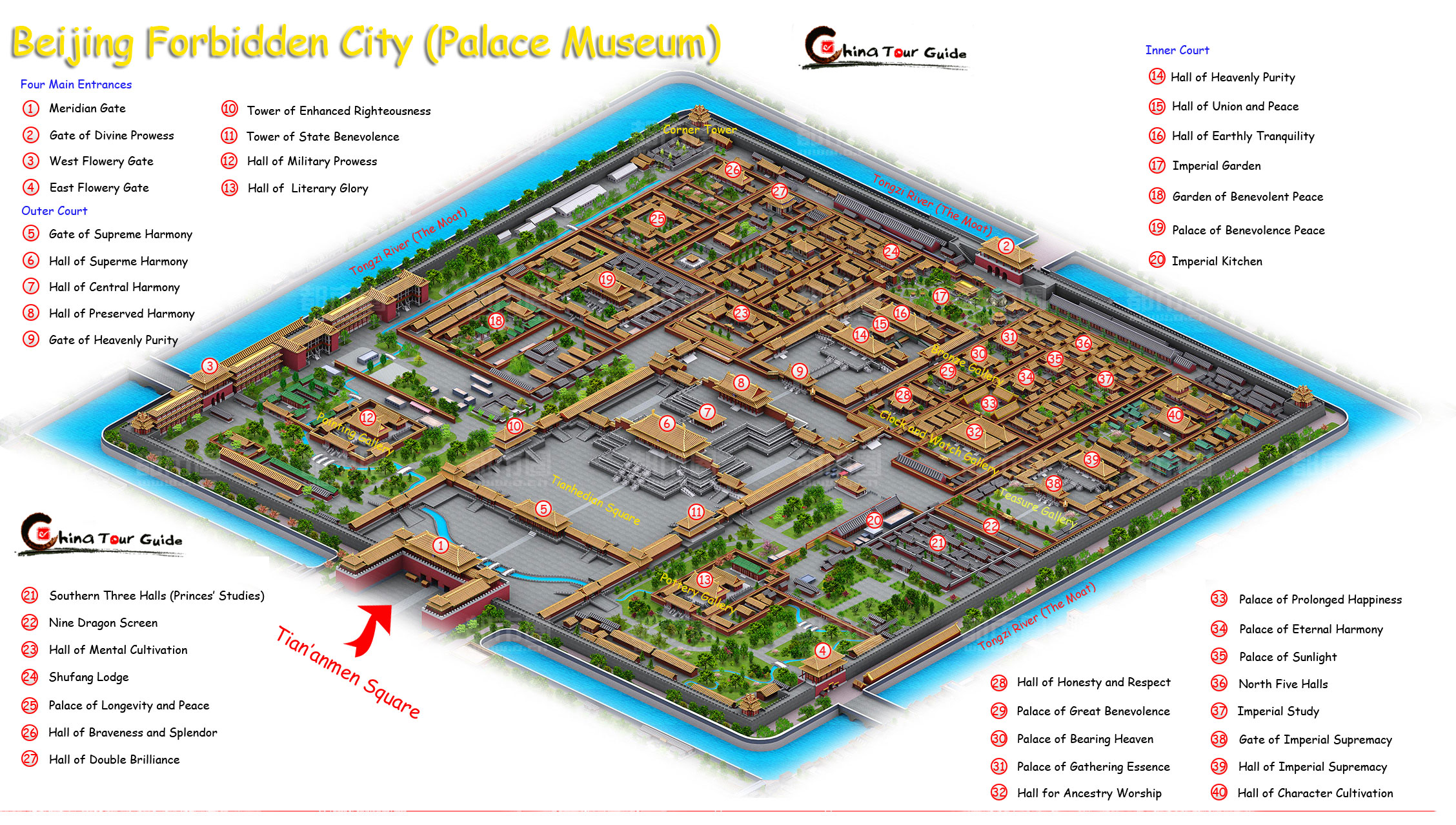
1360-1424. The city is 72-hectare (178 acres). It consists of about 980
buildings, mainly in yellow and red colours, surrounded by a wall 32 feet (10
meters) high and a moat 171 feet (52 meters) wide. Vast numbers of huge stones
were mined and transported there for the city's construction in the 15th and
16th centuries. The heaviest of these giant boulders, aptly named the Large
Stone Carving, now weighs more than 220 tons (200 metric tons) but once weighed
more than 330 tons (300 metric tons).
The city was ordered built by Zhou who lived A.D.
1360-1424. The city is 72-hectare (178 acres). It consists of about 980
buildings, mainly in yellow and red colours, surrounded by a wall 32 feet (10
meters) high and a moat 171 feet (52 meters) wide. Vast numbers of huge stones
were mined and transported there for the city's construction in the 15th and
16th centuries. The heaviest of these giant boulders, aptly named the Large
Stone Carving, now weighs more than 220 tons (200 metric tons) but once weighed
more than 330 tons (300 metric tons).
Important event that took place in the city?
 One of the most important events to happen in the
Forbidden City occurred in 1644. In that year, a rebel army attacked Beijing, forcing
the last emperor of the Ming Dynasty, Zhu Youjian to commit suicide. A Manchu
army from Manchuria was invited by the remaining Ming supporters to march on
Beijing and kick the rebels out. They succeeded but the price of their success
was the founding of a new, Manchu-led, dynasty known as the Qing. Their rulers
would go on to rebuild Beijing, and much of the Forbidden City, after the
devastation brought by the rebel forces. They incorporated Manchu customs into
the daily life of the city while continuing to respect earlier Ming customs.
The Qing Dynasty would be the last imperial dynasty of China, ending in 1912.
One of the most important events to happen in the
Forbidden City occurred in 1644. In that year, a rebel army attacked Beijing, forcing
the last emperor of the Ming Dynasty, Zhu Youjian to commit suicide. A Manchu
army from Manchuria was invited by the remaining Ming supporters to march on
Beijing and kick the rebels out. They succeeded but the price of their success
was the founding of a new, Manchu-led, dynasty known as the Qing. Their rulers
would go on to rebuild Beijing, and much of the Forbidden City, after the
devastation brought by the rebel forces. They incorporated Manchu customs into
the daily life of the city while continuing to respect earlier Ming customs.
The Qing Dynasty would be the last imperial dynasty of China, ending in 1912.
The surrounding of the city?
The Forbidden City is surrounded on three sides by
imperial gardens. To the north is Jing Shan Park, also known as Prospect Hill,
an artificial hill created from the soil excavated to build the moat and from
nearby lakes. To the west lies Zhongnanhai, a former garden centred on two
connected lakes, which now serves as the central headquarters for the Communist
Party of China and the State Council of the People's Republic of China. To the
north-west lies Beihai Park, also centred on a lake connected to the southern
two, and a popular park. To the south of the Forbidden City were two important
shrines – the Imperial Shrine of Family and the Imperial Shrine of State, where
the Emperor would venerate the spirits of his ancestors and the spirit of the
nation, respectively. Today, these are the Beijing Labouring People's Cultural
Hall and Zhongshan Park respectively to the south, two
nearly identical gatehouses stand along the main axis. They are the Upright Gate
and the more famous Tienanmen Gate, which is decorated with a portrait of Mao
Zedong in the centre and two placards to the left and right: "Long Live
the People's Republic of China" and "Long live the Great Unity of the
World's Peoples". The Tienanmen Gate connects the Forbidden City precinct
with the modern, symbolic centre of the Chinese state, Tienanmen Square.
No comments:
Post a Comment