Wednesday, 3 December 2014

Hiroshima And Nagasaki


Nagasaki is the capital and the largest city of Nagasaki prefecture on the island of Kyushu in Japan. Hiroshima is the capital of Hiroshima prefecture, and the largest city in the Chukugo region of western Honshu, the largest island of Japan. In August 1945, during the final stage of the Second World War, the United States dropped atomic bombs on the Japanese cities of Hiroshima and Nagasaki. The two bombings, which killed at least 129,000 people, remain the only use of nuclear weapons for warfare in human history.
Why the Americans attacked Hiroshima and Nagasaki?
The attack on Pearl Harbour was a surprise military strike conducted by the Imperial Japanese Navy against the United States naval base at Pearl Harbour, Hawaii, on the morning of December 7, 1941 . After the attack on Pearl Harbour the Americans decided to take revenge from Japan by attacking the two cities Hiroshima and Nagasaki.
Why Americans did attacked Hiroshima first?
Hiroshima was chosen as the primary target since it had remained largely untouched by bombing raids, and the bomb's effects could be clearly measured. While President Truman had hoped for a purely military target, some advisers believed that bombing an urban area might break the fighting will of the Japanese people. Hiroshima was a major port and a military headquarters, and therefore a strategic target. A uranium gun-type atomic bomb Little Boy was dropped on Hiroshima on August 6, 1945.
Attack on Nagasaki:
At 11:02 am on August 9th, 1945, an all-Christian bomber crew dropped a plutonium bomb, on Nagasaki, Japan. That bomb was the second and last atomic weapon that had as its target a civilian city.
Designs of the Two Bombs:
The Manhattan Project produced two different types of atomic bombs, code-named Fat Man and Little Boy. Fat Man, which was dropped on Nagasaki, was the more complex of the two. A bulbous, 10-ft. bomb containing a sphere of the metal plutonium 239, it was surrounded by blocks of high explosives that were designed to produce a highly accurate and symmetrical implosion. This would compress the plutonium sphere to a critical density and set off a nuclear chain-reaction. Scientists at Les Alamos were not entirely confident in the in the plutonium bomb design, so they scheduled the Trinity test.The Little Boy type of bomb, which was dropped on Hiroshima, had a much simpler design than the Fat Man model that had been tested at Trinity. Little Boy triggered a nuclear explosion, rather than implosion, by firing one piece of uranium 235 into another. When enough U235 is brought together, the resulting fission chain reaction can produce a nuclear explosion. But the critical mass must be assembled very rapidly; otherwise, the heat released at the start of the reaction will blow the fuel apart before most of it is consumed. To prevent this inefficient pre-detonation, the uranium bomb uses a gun to fire one piece of U235 down the barrel into another. The bomb’s gun-barrel shape was believed to be unquestionably reliable and had never been tested. In fact, testing was out of the question since producing Little Boy had used all of the purified U235 produced to date; therefore, no other bomb like it has ever been built. Detonated by a mechanism that resembled a cannon, Little Boy had a muzzle or target that was a hollowed-out sub critical mass of uranium. The cannon ball was another supercritical mass of uranium, which fit perfectly into the hollow of the target as a plug. The plug was propelled down the cannon barrel by several thousand pounds of high explosive. When it hit, the combination of compression and increased mass pushed the uranium to the supercritical level and the bomb went off
Einstein’s role in creating the nuclear bomb:
The physicist Albert Einstein did not directly participate in the invention of the atomic bomb. But as we shall see, he was instrumental in facilitating its development .In 1905, as part of his Special Theory of Relativity, he made the intriguing point that a large amount of energy could be released from a small amount of matter. This was expressed by the equation E=mc2 (energy = mass times the speed of light squared). The atomic bomb would clearly illustrate this principle. But bombs were not what Einstein had in mind when he published this equation. Indeed, he considered himself to be a pacifist. In 1929, he publicly declared that if a war broke out he would "unconditionally refuse to do war service, direct or indirect... regardless of how the cause of the war should be judged.” As Einstein was a Jew he had a deal with America that he would invent a nuclear bomb and in return the Americans had to provide land to the Jews. But it was also committed that the nuclear bomb would never be used as it is the most destructive weapon.
End of the War:

In the end of the World War II the Japanese surrender as the Japanese prime minister once said in his interview that I have seen deaths with unbearable pains. 


Wednesday, 26 November 2014

Adolf Hitler

Early Life:


Adolf Hitler was born on April 20, 1889, the fourth child of Aloise Schickelgruber and Klara Hitler in the Austrian town of Bravura. Two of his siblings died from diphtheria when they were children, and one died shortly after birth. Aloise was a customs official, illegitimate by birth, who was described by his housemaid as a "very strict but comfortable" man. Young Adolf was showered with love and affection by his mother. When Adolf was three years old, the family moved to Passau, along the Inn River on the German side of the border.Between the ages of six and eight, Adolf attended two different schools based upon where his family was living. He was rewarded and praised by his teachers for constantly having high marks and for acting properly in class.Once he was finished with primary school, his father enrolled him in the Realschule which focused more on matters such as science and technology than a traditional curriculum. Klara Hitler died from cancer when Adolf was nineteen and from then onward he had no relatives willing or able to support him. So, in 1909, he moved to Vienna in the hope of somehow earning a living. Within a year he was living in homeless shelters and eating at charity soup-kitchens. He had declined to take regular employment and took occasional menial jobs and sold some of his paintings or advertising posters whenever he could to provide sustenance.In 1913 Adolf Hitler, still a penniless vagrant, moved to Munich in southern Germany. Hitler during world war I At the outbreak of the First World War, in 1914, he volunteered for service in the German army and was accepted into the 16th Bavarian Reserve Infantry Regiment . Hitler fought bravely in the war and was promoted to corporal and decorated with both the Iron Cross Second Class and First Class, the latter of which he wore until his dying day.

Hitler's Wedding:

Eva Anna Paula Braun was born on February 6, 1912, in Munich, Germany, to a school teacher and seamstress. Braun was the middle child of three daughters in a middle-class family and seemed to be the typical teenager, with a major interest in clothes, boys and makeup. She enjoyed outdoor activities and wasn't too interested in her studies, earning average grades.She attended a convent school, but left upon realizing that it wasn't a good fit. She later went to work as a bookkeeper and assistant at the shop of Heinrich Hoffman, who had become Adolf Hitler's personal photographer. Braun met Hitler at the store in 1929, when she was 17 and he was 40, running the National Socialist German Workers Party.n the early 1930 s, Braun and Hitler became more closely involved after one of Hitler's mistresses committed suicide. The exact romantic extent of Braun's relationship with the leader is still not fully known, though Braun expressed deep devotion to the relationship.In early April 1945, Braun traveled from Munich to Berlin to be with Hitler at the Führerbunker. She refused to leave as the Red Army closed in on the capital. After midnight on the night of 28–29 April, Hitler and Braun were married in a small civil ceremony within the futherbunker. The event was witnessed by Joseph Goebbels and Martin Bormann.

Formation Of A Political Nazi Party:


The Nazi Party began as a small group of extremists known simply as the German Labor Party in Munich in 1919. It was started by mainly middle-class workers who were looking to meet and discuss politics. The group was not radical, large, or even a solid political party. In the beginning, they were not popular or even well-known among the general population, but that was soon to change. The powerful voice of Adolf Hitler transformed the German Labor Party into the National Socialist movement that culminated in the establishment of the Third Reich in 1933. Armed with propaganda, a fiery rhetoric, and a pen, Hitler set out to make Germany the greatest empire in the world .This insignificant little party became the National Socialist German Worker’s Party and their membership grew exponentially. It is highly improbable that the Nazis would have come into being without the cunning rhetorical skill of Adolf Hitler and his steadily increasing use of propaganda in the 1920’s. In 1933, they took control of Germany largely due to the incompetence of the Wiemar government and the economic crisis of 1932. Starting less than a month into their term of office, they attempted to completely restructure every aspect of German society from the flag to the economy to traditional holidays. Their overriding vision was to completely alter what it meant to be German using propaganda, censorship and terror on an unprecedented scale.Hitler, after some thought, finally agreed to join the committee and became their seventh official in September 1919.The First Hofbrauhaus Speech Given responsibility for publicity and propaganda, Hitler first succeeded in attracting over a hundred people to a meeting in held October at which he delivered his first speech to a large audience. The meeting and his oratory were a great success, and subsequently in February 1920 he organized a much larger event for a crowd of nearly two thousand in the Munich Hofbrauhaus. Hitler himself was not the main speaker, but when his turn came he succeeded in calming a rowdy audience and presented a twenty-five point programmed of ideas which were to be the basis of the party. The name of the party was itself changed to the National Socialist German Workers Party on April 1st 1920.Not long after the February speech he was discharged from the army. Hitler continued to expand his influence in the party and began to form a private group of thugs which he used to quash disorder at party meetings and later to break up rival party's meetings. This group subsequently became the Sturmabteilung or S.A. - Hitler's brown shirted storm troopers. He also became the regular main speaker at party events from then onward, attracting large crowds for each meeting. During the summer of 1920 Hitler chose the swastika as the Nazi party emblem.

Why Did World War II Started?


After World War I ended in 1918, Germany had to give up land and was banned from having armed forces.In 1933 the German people voted for Adolf Hitler, who led a political party in Germany called the National Socialists or Nazis. Hitler promised to make his country great again and quickly began to arm Germany again and to seize land from other countries.The Second World War was started by Germany in an unprovoked attack on Poland. Britain and France declared war on Germany after Hitler had refused to abort his invasion of Poland.

What Happened In World War II?


World War II was a global war that lasted from 1939 to 1945, though related conflicts began earlier. It involved the vast majority of the world's nations—including all of the great powers eventually forming two opposing military alliances: the Allies and the Axis. It was the most widespread war in history, and directly involved more than 100 million people from over 30 countries. In a state of "total war", the major participants threw their entire economic, industrial and scientific capabilities behind the war effort, erasing the distinction between civilian and military resources. Marked by mass deaths of civilians, including the Holocaust (during which approximately 11 million people were killed)and the strategic bombing of industrial and population centers (during which approximately one million people were killed, including the use of two nuclear weapons in combat) it resulted in an estimated 50 million to 85 million fatalities. These made World War II the deadliest conflict in human history.

What was holocaust:

The Holocaust began in 1933 when Adolf Hitler came to power in Germany and ended in 1945 when the Nazis were defeated by the Allied powers.The term "Holocaust," originally from the Greek word "holocaust" which means "sacrifice by fire," refers to the Nazi's persecution and planned slaughter of the Jewish people. The Hebrew word "Shoah," which means "devastation, ruin, or waste," is also used for this genocide.Hitler hated Jews because he thought that Jews were the people who took victory from Germany in world war I so the holocaust started.On April 1, 1933, the Nazis instigated their first action against German Jews by announcing a boycott of all Jewish-run businesses.Nazis then issued additional anti-Jews laws over the next several years. For example, some of these laws excluded Jews from places like parks, fired them from civil service jobs (i.e. government jobs), made Jews register their property, and prevented Jewish doctors from working on anyone other than Jewish patients.After World War II started in 1939, the Nazis began ordering Jews to wear a yellow Star of David on their clothing so that Jews could be easily recognized and targeted.After the beginning of World War II, Nazis began ordering all Jews to live within certain, very specific, areas of big cities, called ghettos.It is estimated that 11 million people were killed during the Holocaust. Six million of these were Jews.The Nazis killed approximately two-thirds of all Jews living in Europe.An estimated 1.1 million children were murdered in the Holocaust. 

Hitler's Death

 After 40 hours of Hitler's wedding, Adolf Hitler committed suicide by gunshot on 30 April 1945 in Berlin. His wife Eva  committed suicide with him by ingesting cyanide. Hitler committed suicide because he had been defeated by the Russians and the Russians were going to take revenge from Hitler because of his cruelty towards Jews.  The bodies of Hitler and Eva were cremated in the chancellery garden by the bunker survivors as per Hitler's order.

There are many movies revealed on the life of Adolf Hitler and the top ones are "The Downfall,The Nazis,The Valkyrie,The Inglorious Bastards and The Olympia.


Wednesday, 19 November 2014

Forbidden City
Home Of Chinese Emperors
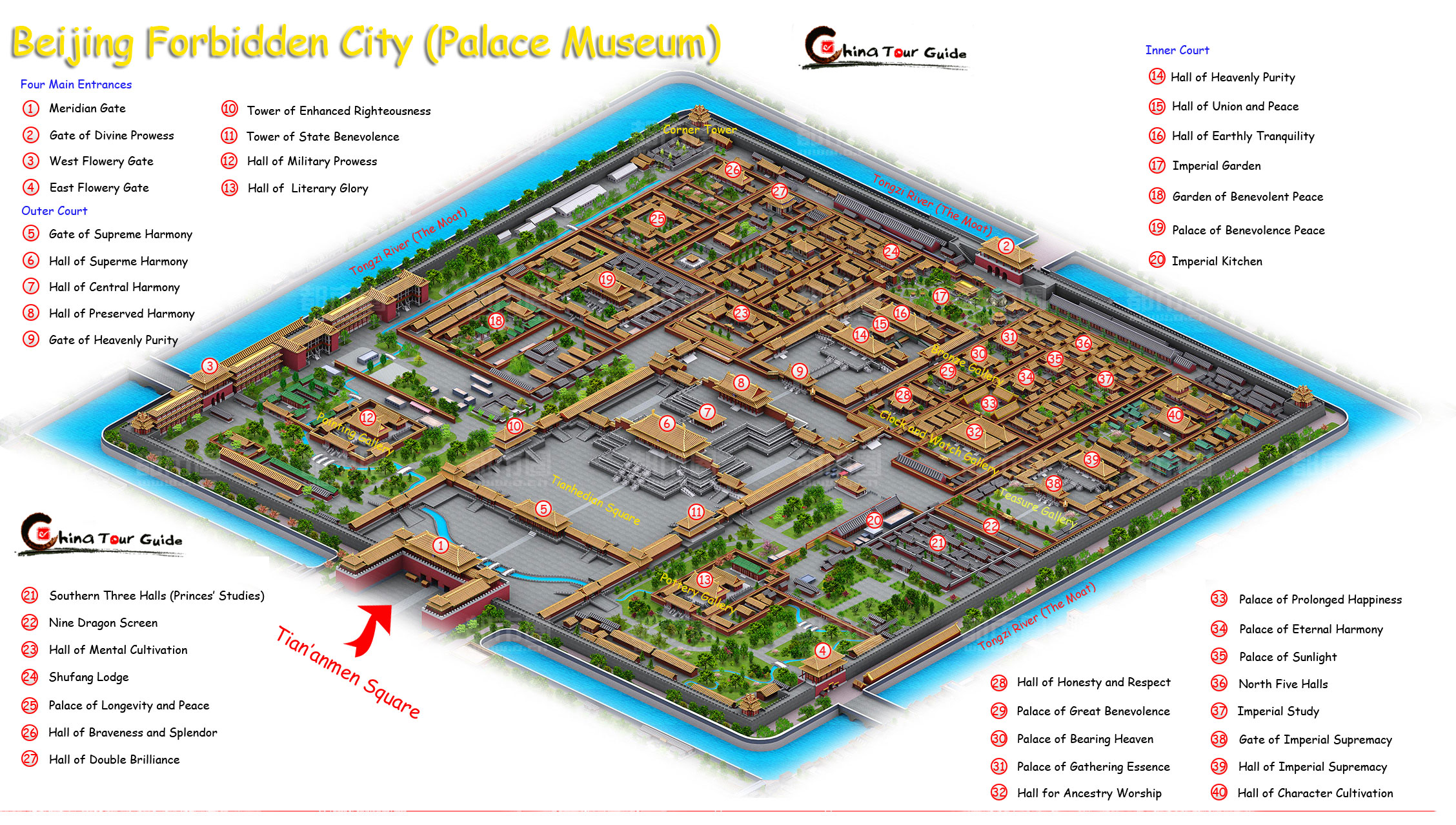
The Forbidden City was the Chinese imperial palace from the Ming dynasty to the end of the Qing dynasty. It is located in the centre of Beijing, China. It served as the home of emperors. Is was built in 1406 to 1420.The Forbidden City was declared a World Heritage Site in 1987.
Built up of the city?
The city was ordered built by Zhou who lived A.D. 1360-1424. The city is 72-hectare (178 acres). It consists of about 980 buildings, mainly in yellow and red colours, surrounded by a wall 32 feet (10 meters) high and a moat 171 feet (52 meters) wide. Vast numbers of huge stones were mined and transported there for the city's construction in the 15th and 16th centuries. The heaviest of these giant boulders, aptly named the Large Stone Carving, now weighs more than 220 tons (200 metric tons) but once weighed more than 330 tons (300 metric tons).
Important event that took place in the city?
One of the most important events to happen in the Forbidden City occurred in 1644. In that year, a rebel army attacked Beijing, forcing the last emperor of the Ming Dynasty, Zhu Youjian to commit suicide. A Manchu army from Manchuria was invited by the remaining Ming supporters to march on Beijing and kick the rebels out. They succeeded but the price of their success was the founding of a new, Manchu-led, dynasty known as the Qing. Their rulers would go on to rebuild Beijing, and much of the Forbidden City, after the devastation brought by the rebel forces. They incorporated Manchu customs into the daily life of the city while continuing to respect earlier Ming customs. The Qing Dynasty would be the last imperial dynasty of China, ending in 1912.
The surrounding of the city?
The Forbidden City is surrounded on three sides by imperial gardens. To the north is Jing Shan Park, also known as Prospect Hill, an artificial hill created from the soil excavated to build the moat and from nearby lakes. To the west lies Zhongnanhai, a former garden centred on two connected lakes, which now serves as the central headquarters for the Communist Party of China and the State Council of the People's Republic of China. To the north-west lies Beihai Park, also centred on a lake connected to the southern two, and a popular park. To the south of the Forbidden City were two important shrines – the Imperial Shrine of Family and the Imperial Shrine of State, where the Emperor would venerate the spirits of his ancestors and the spirit of the nation, respectively. Today, these are the Beijing Labouring People's Cultural Hall and Zhongshan Park respectively to the south, two nearly identical gatehouses stand along the main axis. They are the Upright Gate and the more famous Tienanmen Gate, which is decorated with a portrait of Mao Zedong in the centre and two placards to the left and right: "Long Live the People's Republic of China" and "Long live the Great Unity of the World's Peoples". The Tienanmen Gate connects the Forbidden City precinct with the modern, symbolic centre of the Chinese state, Tienanmen Square.


Friday, 14 November 2014


Pearl Harbor

"a date that will live infamy"

The attack on Pearl Harbor was a surprise military strike conducted by the imperial Japanese Navy against the United State naval base at Pearl Harbor, Hawaii, on the morning of December 7, 1941. The attack led to the United States' entry into World War II. President Franklin Roosevelt called December 7 1941 "a date that will live infamy"

What caused the attack on Pearl Harbor?
The causes of the attack on Pearl Harbor originated from intensifying Japanese-American rivalry in the Pacific. Japan’s imperial ambitions had been evident from as early as 1931, when she invaded Manchuria. The conquered region’s bountiful resources were then used to supply Japan’s war machine. Leaving the League of Nations in 1933, Japan pursued an aggressive foreign policy aimed at creating the ‘Greater East Asia Co-prosperity Sphere’s understatement for the Japanese empire modeled on European ones of the 19th century.


What happened on 7 December 1941?
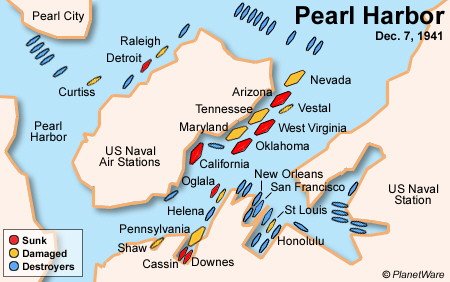
On the morning of December 7, 1941, the Japanese launched a surprise air attack on the U.S. Naval Base at Pearl Harbor in Hawaii. After just two hours of bombing, more than 2,400 Americans were dead, 21 ships had either been sunk or damaged, and more than 188 U.S. aircraft destroyed. The attack at Pearl Harbor so outraged Americans that the U.S. abandoned its policy of isolationism and declared war on Japan the following day, officially bringing the United States into World War II. Sunday mornings were a time of leisure for many U.S. military personnel at Pearl Harbor. Many were either still asleep, in mess halls eating breakfast, or getting ready for church on the morning of December 7, 1941. They were completely unaware that an attack was imminent. Then the explosions started. The loud booms, pillars of smoke, and low-flying enemy aircraft shocked many into the realization that this was not a training exercise; Pearl Harbor was really under attack.


What did the eye witness Johnnie and Dale Gino saw?  
They lived in Pearl City on a peninsula which jutted out into Pearl Harbor parallel to Ford Island on which the Naval Air Station was based. Navy ships were tied to piers on the east and west sides of Ford Island and at the south end of Pearl City peninsula. There were others at the shipyard east across the bay from Ford Island. A very loud explosion rattled our windows. We rushed outside to see a string of air planes in a shallow dive toward the ships at the end of our peninsula. We could see red anti-aircraft tracer shells floating up toward the lead aircraft. We could see the "Rising-Sun" emblem that decorated the side of the aircraft which identified them as Japanese. My wife and her friends who lived nearby went up into the hills to hide in a cave and we caught a boat to Ford Island. On the way over we saw a large flight of Japanese aircraft fly over at a high altitude. We saw sunken U.S. Navy ships on both sides of Ford Island burning furiously. When we got to the east side of Ford Island we could see large fires in the Navy Yard which is across the water east of Ford Island. We lost no aircraft carriers because they were at sea. The ships which were docked in the spaces used by the carriers were sunk and burning. We saw some very brave Navy Yard workers cutting holes in the bottom of ships that had rolled over and sunk. They saved quite a few sailors who were trapped in the ships. We saw an oil covered sailor who looked familiar .We had gone to high school together. He was lost later in the war. When we went into the barracks later in the day we saw long rows of dead and injured sailors lying on the floor. Visualize yourself standing on the east side of Ford Island looking across the water toward the Navy base. The submarine base is to your left, the shipyard straight across and the Navy Hospital far to the right on the point of land. The last attacking Japanese air plane we saw dove to rooftop height above the submarine base, flew across the shipyard and climbed steeply over the hospital and flew away. The last Japanese air plane we saw was one we had shot down. It was dragged up a ramp where we were able to take a cartridge from a jammed machine gun and remove a nameplate from a wing for souvenirs.


An American film of the same name "Pearl Harbor "was also realized in 2001 based on the true story of two army officers.

Monday, 3 November 2014


History Of Titanic

Titanic the unbreakable

A century has sailed by since the luxury ship Titanic met its disastrous end in the North Atlantic, plunging two miles to the ocean floor after the clash, an iceberg during its maiden voyage. Rather than the intended Port of New York, a deep-sea grave became the pride of the White Star Line’s final destination in the early hours of April 15, 1912. More than 1,500 people lost their lives in the disaster.

Dimension And Layout Of The Ship:

Titanic was 882 feet 9 inches  long with a maximum breadth of 92 feet 6 inches. Her total height, measured from the base of the keel to the top of the bridge, was 104 feet. It measured 46,328 gross register tons and with a draught of 34 feet 7 inches, she displaced 52,310 tons.Titanic carried a total of 20 lifeboats: 14 standard wooden and  lifeboats with a capacity of 65 people each, lifeboats with a capacity of 47 people each. In addition, she had two emergency cutters with a capacity of 40 people each.

Launch Of Titanic:

Titanic was launched at Harland & Wolff’s yard at Queen Island, Belfast on May 31, 1911 in the presence of thousands of ticket-holding spectators and more than a hundred of the press people.  It was a spectacular occasion, not just because one of the two largest vessels in the world was taking to the water, but because the great and good were in attendance.

A romantic movie based on titanic was released in the year 1997.


Thursday, 23 October 2014

CELL-O-MANIA


Picture
In this world full of technologies cell phones are widely used. Everyone in this world have one or more cell phones. This craze of  cell phones is so high that people check new cells to buy on internet. We all are suffering from Cell-O-Mania and it is actually very hard to get free from this craze. Mania is the mood of an abnormally elevated arousal energy level and we are all suffering from Cell-O-Mania. Due to Cell-O-Mania people spend more time using their cell phones than physical face to face communication. Cell phones, taking them in a positive manner, means advantageous manner, mobiles are used to communicate each other. They are used to get weather updates, finding location through Maps and Mobiles, taking them in a positive, means advantageous manner, mobiles are used to communicate each other. They are used to get weather updates, finding location through Maps , for educational purposes, emergency calls. They have calculator as an application for calculating a big amount. A dictionary to consult and help while studying. The disadvantages are to use it badly and getting addicted to it. It can be a harm to your eyes. Can prove to be a big wastage of time on study time or others. Teenagers and growing children can download applications that are not meant for them. People use internet for bad purposes with full privacy. The people use YouTube for bad purposes. Using too much mobile can even lead to brain damage .Migraine, a type of headache can also be caused due to using too much mobile. This can cause us bad marks in exams if we waste our study time on mobile phones which seems more attractive. This can cause us back ache, if we sit all day and keep using mobile phones, can cause muscle fatigue and make us fat. According to a scientific research, cell phones produce such a radiation that can cause cancer. Beside all these things, mobile phones have advantages and some disadvantages as well but limited time and proper care id needed to operate cell phones so that our work is done with no harms. Cell phones have totally impressed our generation one way  or the other but we have to be careful because they can cause many harmful affects to our life.

Thursday, 2 October 2014


DIGNITY


Moral, ethical, legal, and political discussions use the concept of dignity to express the idea that a human  being has an innate right to be valued and to receive ethical treatment. In the modern context dignity can function as an extension of the  enlighten era concepts of inherent rights. English-speakers often use the word "dignity" in proscriptive and cautionary ways.

History  Of  Dignity:

Over the last 60 years the idea of human dignity has become increasingly prominent in the political discourse on human rights. In United Nations documents, for instance, human dignity is currently presented as the justification for human rights. An annual Dignity Day on October 20 was arranged for the first time in 2008.

Quotation On Dignity:

1:There are two kinds of pride, both good and bad. 'Good pride' represents our dignity and self-respect. 'Bad pride' is the deadly sin of superiority that reeks of conceit and arrogance.

2:Life is not a matter of place, things or comfort; rather, it concerns the basic human rights of family, country, justice and human dignity.